 Portfolio of Keith Elder
How Will Quantum Computing Impact Our Business?
by Keith Elder
Keith Elder is the Senior Technology Evangelist on the Quicken Loans Emerging Technology team. This team looks to the future to see how new technologies can impact the business.
Hype has been building around quantum computing. It’s even reached mainstream media, with articles announcing the latest breakthroughs showing up in our news feeds regularly. Recently, Dan Gilbert had Dr. Shohini Ghose on “The Speed of the Game” podcast to discuss quantum physics and computing.
It’s fun speculating about quantum computing, but in reality, it’s many years away from becoming mainstream – much further away than the hype might suggest.
Let me start by saying, I'm not an expert in quantum computing – but I am a technologist. I hope my experience and observations can help make sense of where this technology is today.
Think of quantum computing as a brand-new engine for a computer, much more sophisticated and 100% different from the current engines.
Think about those bad sci-fi movies where you see a spaceship land, and it makes no noise, no wind and no visible heat. It sounds crazy, but that's kind of like the quantum computing engine.
It’s unlike anything we've ever seen or experienced. Quantum computers are so sophisticated, there are debates if they really exist at all.
The first computers were huge, and so are the first attempts at creating a quantum computer, although they aren't quite as large as their predecessors.
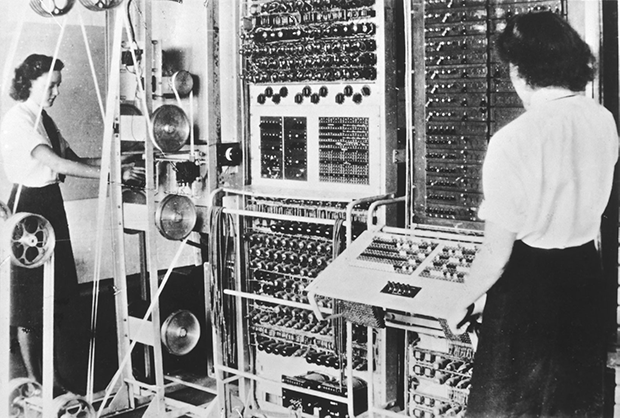
Above: Colossus, the first electric programmable computer, built in 1943
These computers require specialized environments, cooled to .015 Kelvin. (That’s astronomically cold!)
The actual processor must be placed in a dilution refrigerator, shielded to 50,000 times less than the Earth's magnetic field. It also needs to be to be placed in a high vacuum to 10 billion times lower than atmospheric pressure. It also needs calibrating several times a day and is highly prone to error. In other words, no one’s going to be carrying a quantum computer around in their pocket any time soon.
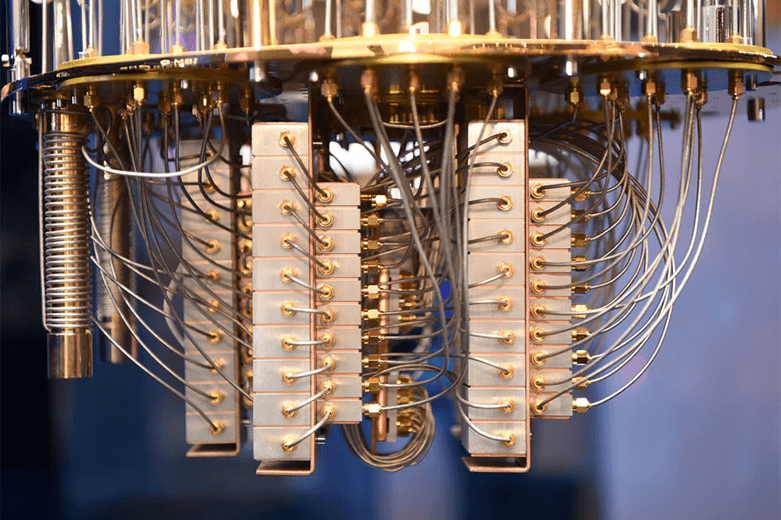
Above: The IBM Q System One Quantum Computer
So why all the fuss? Part of it is due to a general tendency for things to get hyped up online. We see quantum computing mentioned everywhere. But that's only part of the story.
Some of this hype is deserved, because one day, we might use quantum computers for all sorts of super interesting things that will have a drastic impact on our lives, like breaking current encryption methodologies, machine learning and artificial intelligence (faster calculations), chemistry (new fertilizers), biochemistry (new drugs), finance (faster Monte Carlo simulations), health care (DNA sequencing), materials (corrosion-proof paints) and computer science (faster multidimensional search).
In reality, we’re many years away from seeing any benefits from a quantum computer. Due to their sophistication and upkeep, most companies won’t even own one in the future, but rather rent time through what will become known as Quantum Computing as a Service (QCaaS).
While quantum computing promises a lot in the future, it’s too early to spend much time digging into its uses.
On the Research and Prototyping team, we look into the future and see how technologies can alter our business. While we love to dream about the future, we also must balance practicality. So, we’ll be keeping quantum computing on our distant radar.
It’s hard to say just when it will start to become viable, but I suspect we'll see much progress over the next 5-10 years. It will be a while before developers have the tools they'll need to build reliable software programs.
Another thing to consider during all the hype is that quantum computing may turn out to be another step we'll look back 10 years down the line and say, “We learned a lot, but it just didn't work out.”
Remember Thomas Edison, the guy who invented the light bulb? Before he was successful, he made 1,000 unsuccessful attempts. When a reporter asked, "How did it feel to fail 1,000 times?" Edison replied, "I didn't fail 1,000 times. The light bulb was an invention with 1,000 steps."
Maybe quantum computing is the invention, but maybe it’s just a step to something even more powerful. We'll have to wait and see.
If you’d like more information about how quantum computing works check out CNOT, an educational resource on quantum computing.
What do you think we’ll be using quantum computing for in 10 years? Let me know in the comments!