 Portfolio of Keith Elder
Speaking - Building a Story
by Keith Elder and Sarah Kindinger
Now that we have an outline, it's time to start crafting our story. Stories are the most powerful delivery tool for information and the currency of human relationships. In Nancy Duarte's book "Resonate" she says, "Stories have been told for thousands of years to transfer cultural lore and values. When a great story is told, we lean forward and our hearts race as the story unfolds. Can that same power be leveraged for a presentation? Yes. The timeless structure of a story can contain information that persuades, entertains and informs. A story serves as a perfect device to help an audience recall the main point and be moved to action. Once a presentation is put into story form, it has structure, creates an imbalance the audience wants to see resolved and identifies a clear gap that the audience can fill."
The Golden Rule
- Tell them what you’re going to tell them
- Tell them
- Tell them what you told them
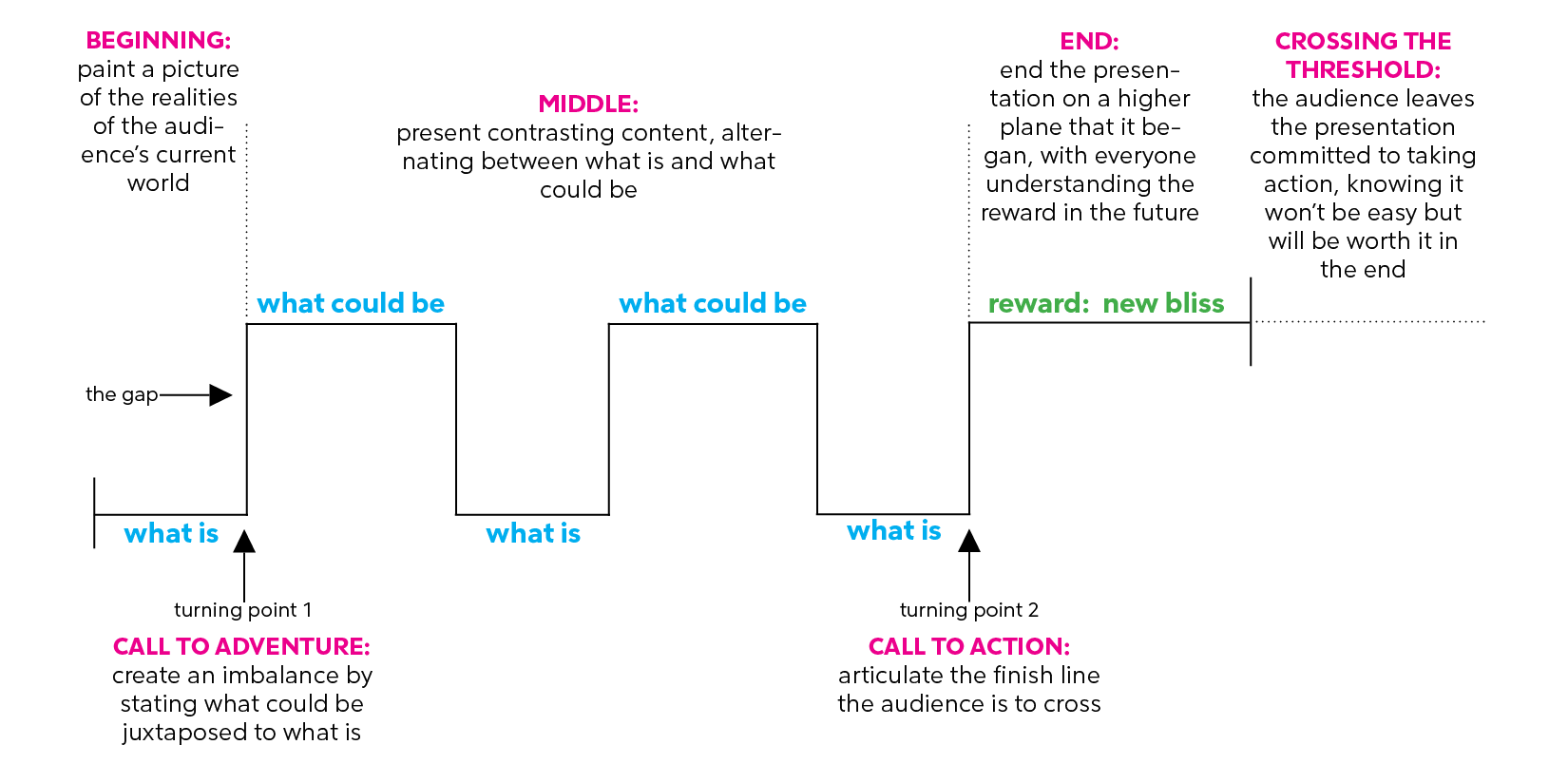
When constructing a story we recommend following Nancy Duarte's "The Presentation Form or Spark Line." "The Presentation Form" draws insights from mythological, literary and cinematic structures. This is the secret sauce to telling a good story. Don't forget to keep it simple. It's better to deliver less information that people can actually follow and understand vs. trying to put as much content as possible into a shorter time frame.
Every story has a beginning, middle and end. In a good story, there are also two turning points that help the audience clearly distinguish the beginning from the middle and the middle from the end. The middle will move up and down to keep the audience engaged as you unwrap ideas and perspectives. The conclusion ends with a vivid description of the new world that will be available to them once they adopt the idea.
Example: Spark Line
Things to Consider
When you're writing a good story, it's easy to get caught up that the message you want to deliver. You've probably seen many examples of speakers that only tell you what they want to hear. Great presenters or storytellers make the audience the hero. As you're crafting your story, make everything about the audience. What do they want to hear? Why do they care? What will resonate with them? Answers to these questions are how to keep them engaged and make your tale something they're going to remember.
Humor can be really tricky. Although your friends and family think you're the funniest person ever, that doesn't mean that everyone will. Humor can be a great way to connect with your audience. The goal of humor is to get your audience to laugh which doesn't mean you have to tell a joke. In fact, jokes can actually detract from your credibility and message. The key to using humor is to customize it based on your audience analysis. A comment is humorous when it sets up an expectation then breaks it. Look for stories in everyday life that can educate, entertain and maybe even make your audience laugh.
You can have a lot of great content in the middle, but the beginning and end are the most important parts of your talk. Realistically, the audience will only remember 10% of your talk and most likely that will be the first and last things they hear. That's why a strong beginning which paints the picture of the current reality and an end with a call to action to help the audience understand clearly the reward is so important. As you look over your thoughts and outline, think about the most impactful things that'll resonate with the audience. Again, they're the hero and the reason you're on stage.